


World Games of Gig Delivery Drivers End With Astounding Results
Records shattered, bags carried, apartments located, and one restaurant is reportedly still saying “five more minutes.”
The World Games of Gig Delivery Drivers have officially concluded, bringing together the finest delivery athletes from around the globe for several days of competition, confusion, questionable parking and absolutely no guaranteed hourly wage.
Organizers are calling this year’s Games the most successful ever, although they acknowledged that 14 competitors are still trying to find Building C.
The closing ceremonies were briefly delayed after the driver carrying the ceremonial torch received a better offer going in the opposite direction.
Here are the final results.
 Maximum Walmart Bag Carry
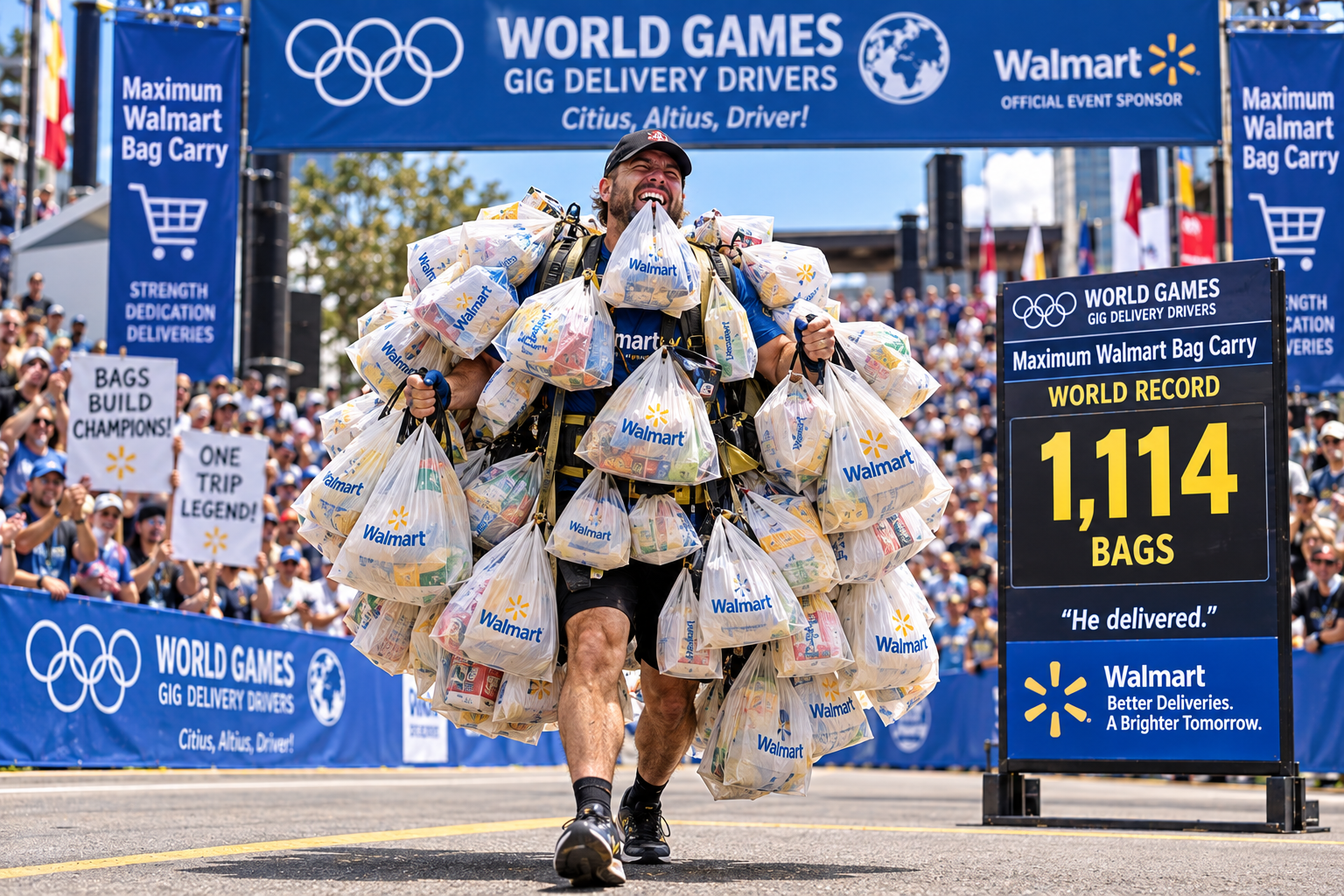
The most anticipated event of the Games did not disappoint. Competitors were required to transport an entire Walmart grocery order from their vehicles to a customer’s door in one trip.
Carts were prohibited. Returning to the vehicle was an automatic disqualification. Canada’s Joseph S. stunned spectators by carrying 1,114 bags simultaneously, establishing a new world record.
Judges confirmed that Joseph used both hands, both arms, his teeth, his belt, six fingers that officials are still trying to account for, and two reusable bags suspended from pierced earrings.
A protest filed by the United States was rejected after officials ruled that earrings constitute legal auxiliary attachment points under International Gig Delivery Federation rules. Joseph was unable to attend the medal ceremony because his fingers had not yet reopened.
 Restaurant “Five More Minutes” Endurance
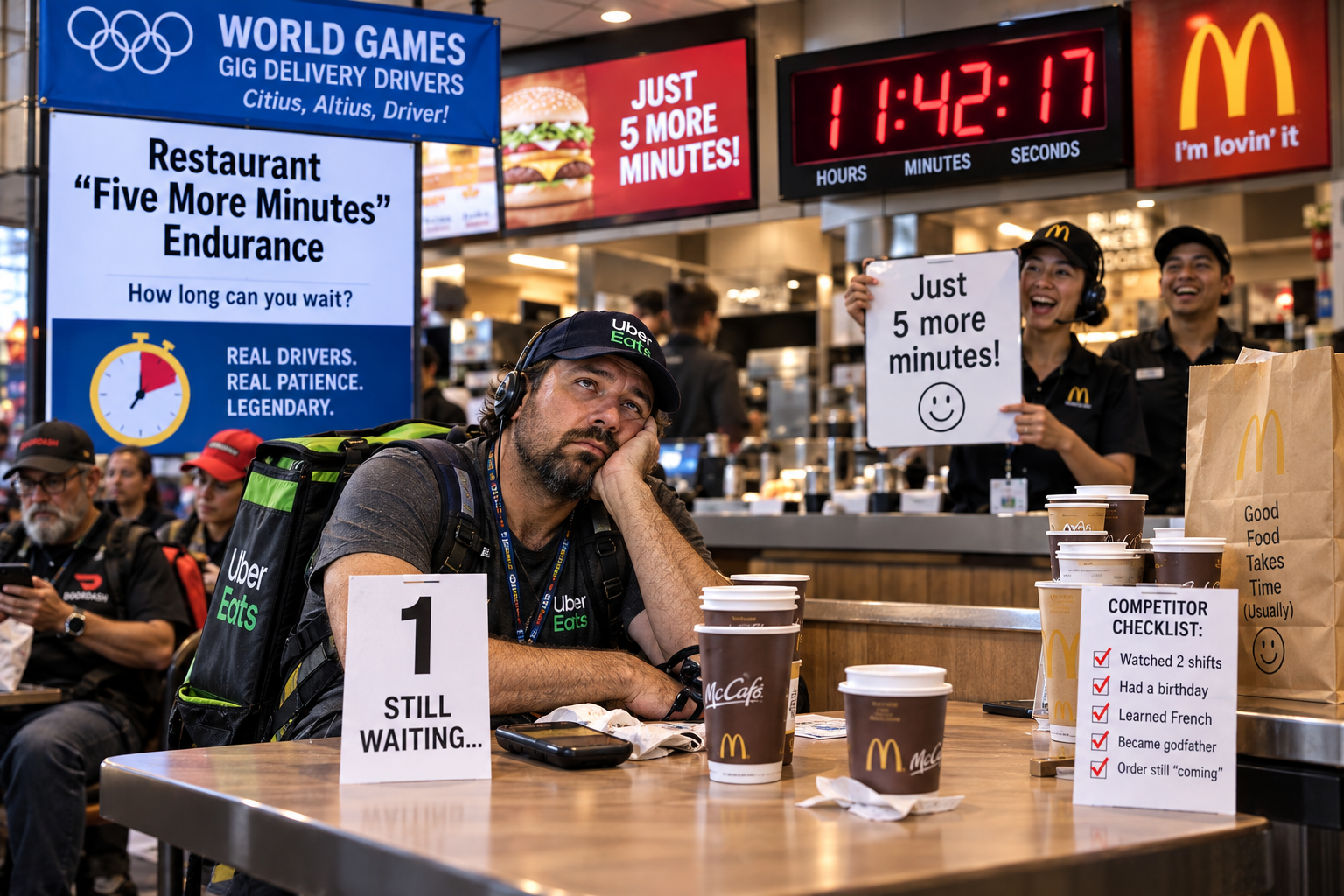
The defending world champion was finally defeated.
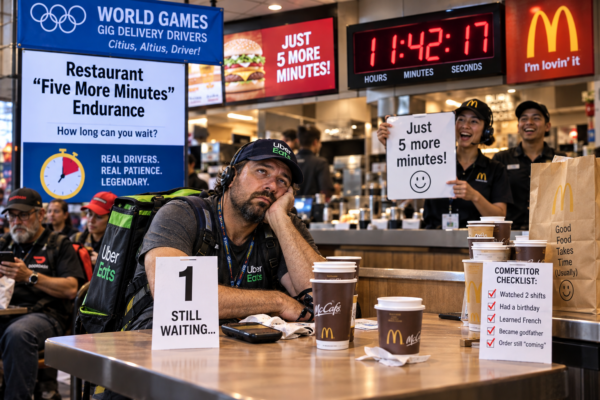
Competitors entered participating restaurants after being told their order would be ready in “about five minutes.” The clock then started. Brazil’s Carlos Mendes captured gold after remaining beside the pickup counter for 11 hours, 42 minutes without unassigning the order.
During the competition, Carlos watched two restaurant shifts come and go, celebrated a birthday, learned conversational French on his phone and became godfather to one employee’s newborn child.
At the 10-hour mark, restaurant staff assured him: “Just five more minutes.” The order was ultimately discovered sitting on a shelf behind him.
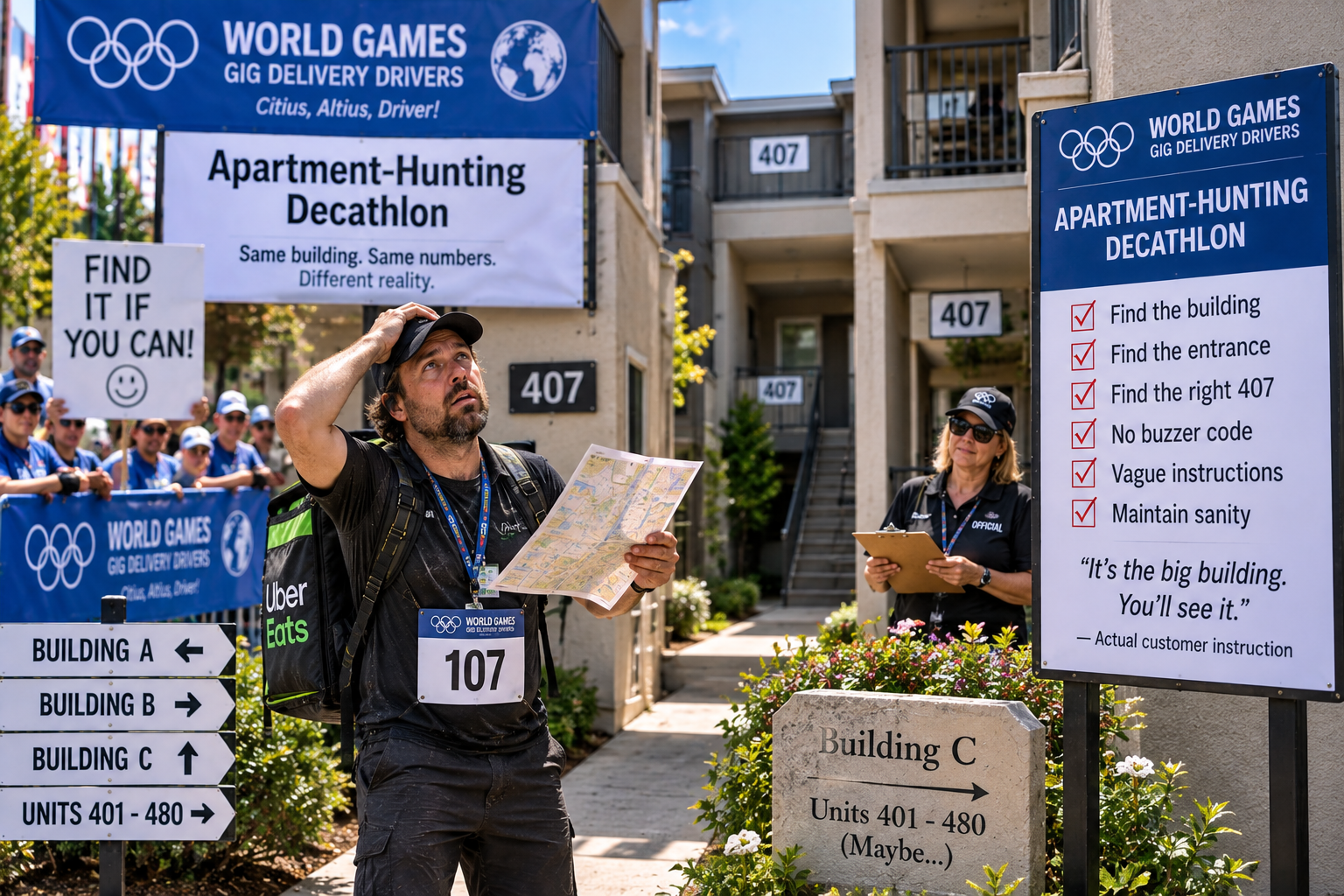
Apartment-Hunting Decathlon
This year’s course was described by several athletes as “inhumane.”
Drivers were given an apartment number, a locked exterior door, no buzzer code and customer instructions reading: “I’m in the big building. You’ll see it.”
Kenya’s Miriam Wanjiku won gold after locating Apartment 407 in only 47 minutes. The achievement was particularly remarkable because the building had three separate sections numbered 407.
Silver medalist Trevor MacDonald of Canada remains missing. Officials say his last known location was Stairwell B.
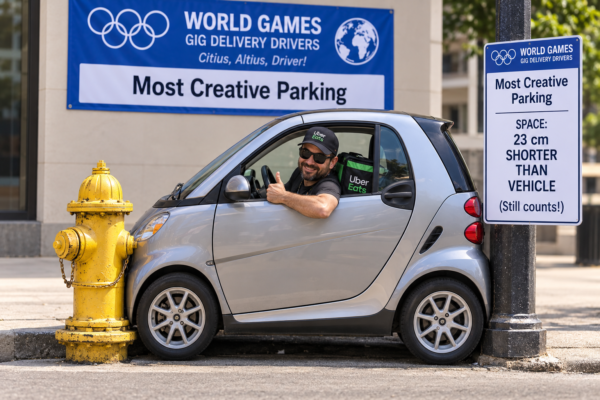 Most Creative Parking
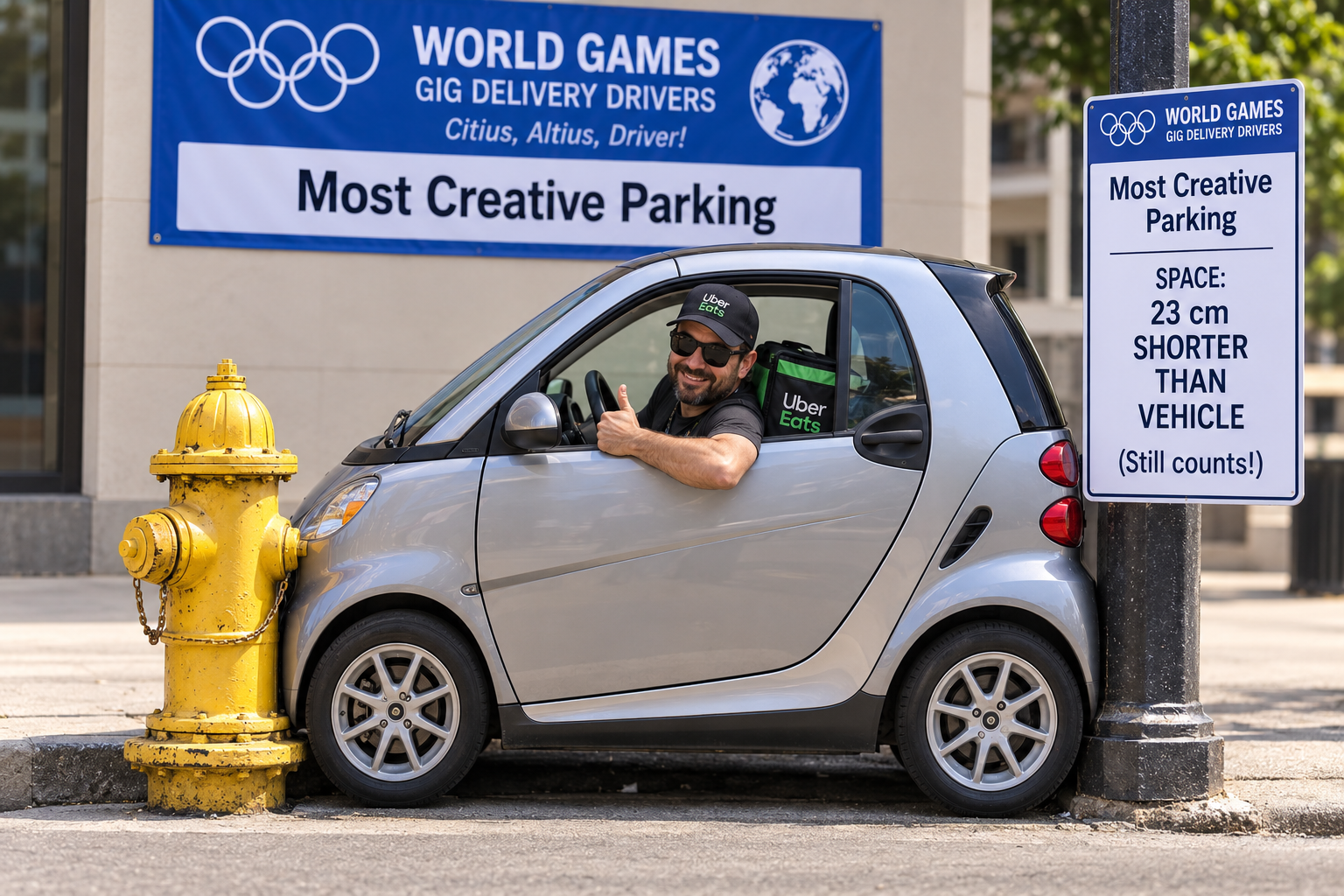
Italy dominated an event it has traditionally performed well in.
Competitors had to legally—or at least imaginatively—park within reasonable walking distance of a downtown restaurant during the dinner rush. Gold medalist Luca Bianchi managed to position a Fiat in a space measuring 23 centimetres shorter than the vehicle. Officials have declined to explain how.
France earned silver after its competitor successfully parked between a fire hydrant, a bicycle rack and what judges initially believed was public art. The Canadian entry was disqualified after finding an actual parking space.
Judges ruled this gave him an unfair advantage.
 Stacked-Order Route Optimization
Drivers were given three restaurant pickups and four customer deliveries while the app continuously rearranged the route for reasons known only to the app.
Japan’s Akira Tanaka appeared headed for gold after calculating a route requiring only 18.7 kilometres. The app immediately changed it to 46. Tanaka recalculated. The app changed it to 71. After six route changes, Tanaka turned off navigation and followed a pigeon.
He won by nine minutes.
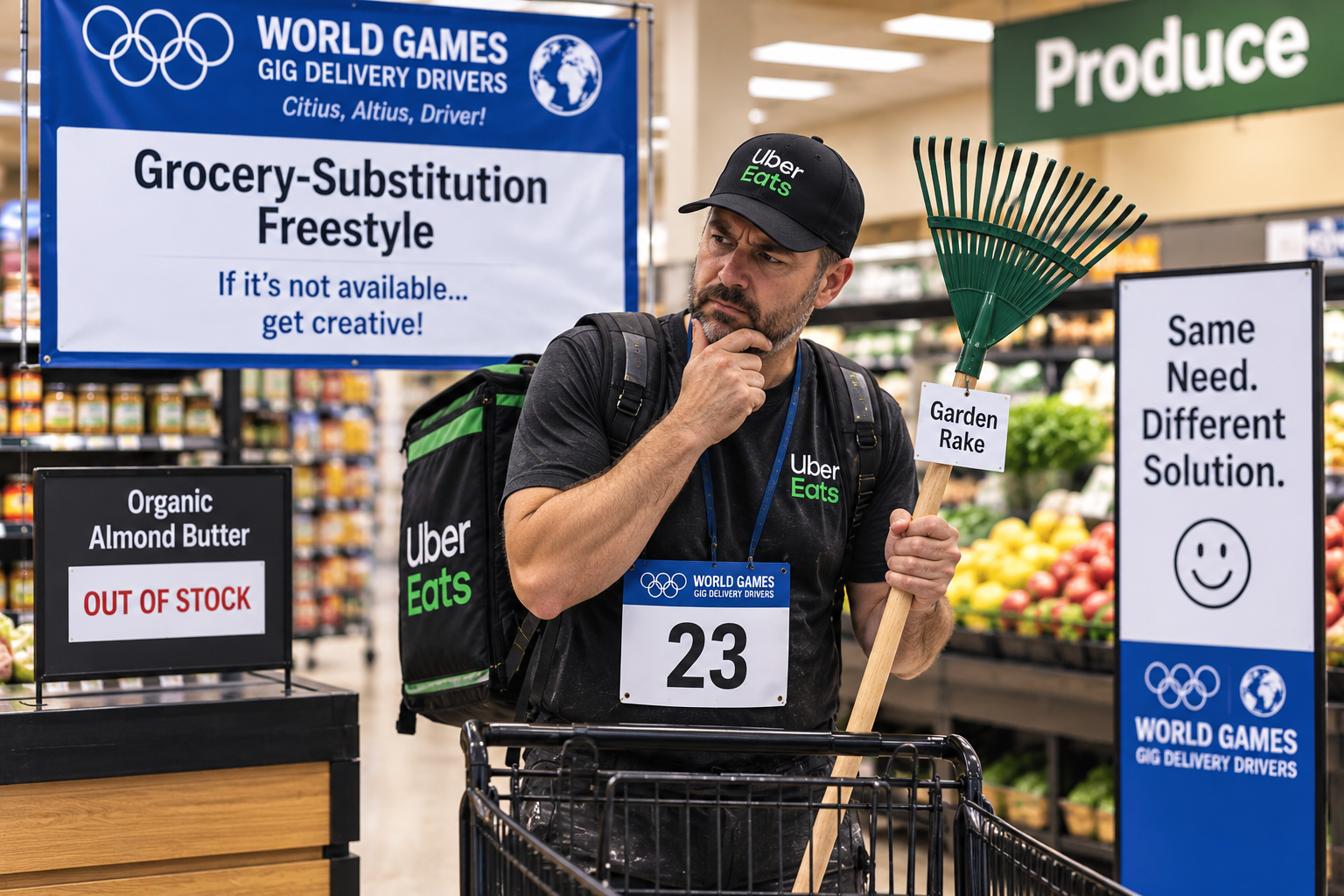
Grocery-Substitution Freestyle
Competitors were asked to find replacements for products unavailable in the store while maintaining customer satisfaction.
The decisive moment came when Australia’s Chloe Wilson was instructed: Customer requested: Organic unsalted almond butter.
None was available. After 14 unanswered messages, Chloe substituted a garden rake. The customer approved the substitution. Judges awarded a perfect 10. The customer later reduced the tip.
 Doorstep Precision
Drivers competed to place food at a customer’s door without blocking the door from opening. It sounds easy. It wasn’t. Of 128 competitors, 117 were eliminated in the first round.
Gold went to Norway’s Erik Johansen, who successfully determined that an outward-opening screen door requires approximately three feet of clearance. The achievement is already being described as one of the greatest intellectual breakthroughs in delivery history.
Customer-Directions Interpretation
Competitors received actual-style delivery instructions and were required to determine where the customer lived. The championship instruction read:
“Turn where the old gas station used to be, go past Dave’s place, don’t take the second driveway unless you come from the other direction, and we’re the house with the car.”
No competitor finished. Gold was eventually awarded to the driver who had the courage to call the customer.
Road-Closure Maze
Drivers had to complete a 4-kilometre delivery through a downtown area containing construction, one-way streets, temporary detours and a navigation app unaware that a bridge had ceased to exist six months earlier.
India’s Priya Sharma won after completing the course in three hours and eight minutes. Her navigation system announced “You have arrived” 37 times. At one point she was in a lake. Judges awarded bonus points because the food remained warm.
Fastest Cancellation After Acceptance
This event lasted considerably less time than organizers expected. The world record now stands at 0.73 seconds. American competitor Marcus Reed accepted a $3.14 delivery travelling 19 kilometres.
Witnesses report that his thumb had already begun moving toward the cancel button before his brain had finished processing the offer. Sports scientists are calling this “anticipatory regret.”
Voice-to-Text Deciphering
Drivers were shown messages produced by customers using voice recognition and asked to determine what they meant. The gold-medal message was: “Leave it by the grey whale beside my ants don’t ring the doctor babysleeping.”
After extensive analysis, Canada’s Rebecca Chen correctly interpreted this as: “Leave it by the grey wall beside my plants. Don’t ring the door. Baby sleeping.” Her performance received a standing ovation. Google has requested the tape.
Highest Number of App Crashes in One Shift
This year’s competition produced controversy after several athletes argued that performance depended more heavily on the app than on the driver. Organizers disagreed.
Mexico’s Diego Hernández captured gold with 43 crashes in six hours, including seven during active deliveries and three while attempting to report that the app had crashed.
His phone remained fully operational throughout. Officials therefore confirmed the crashes as legitimate.
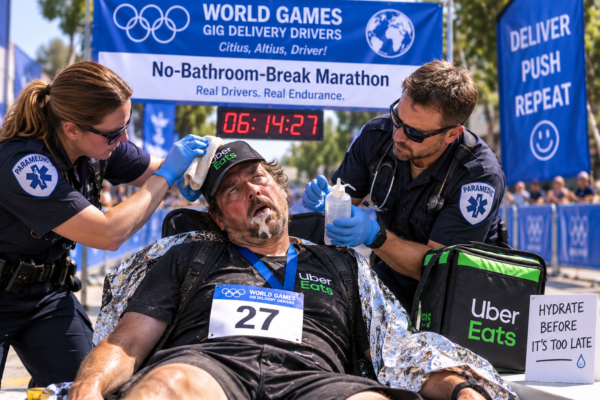
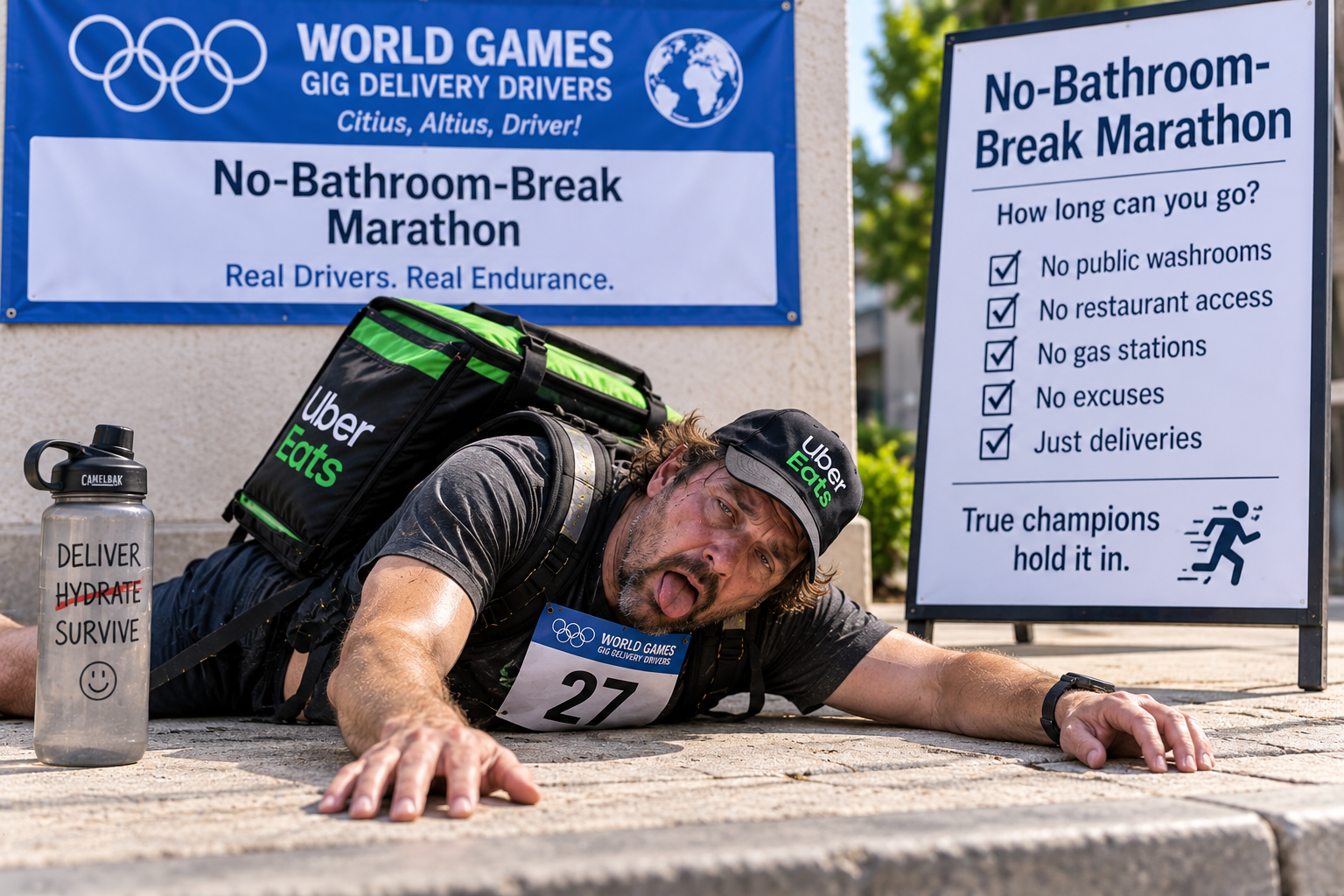
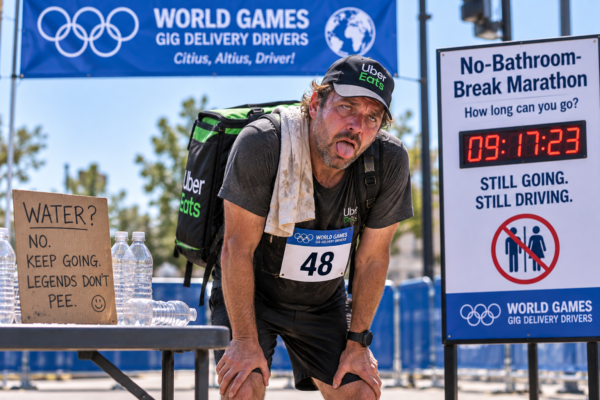
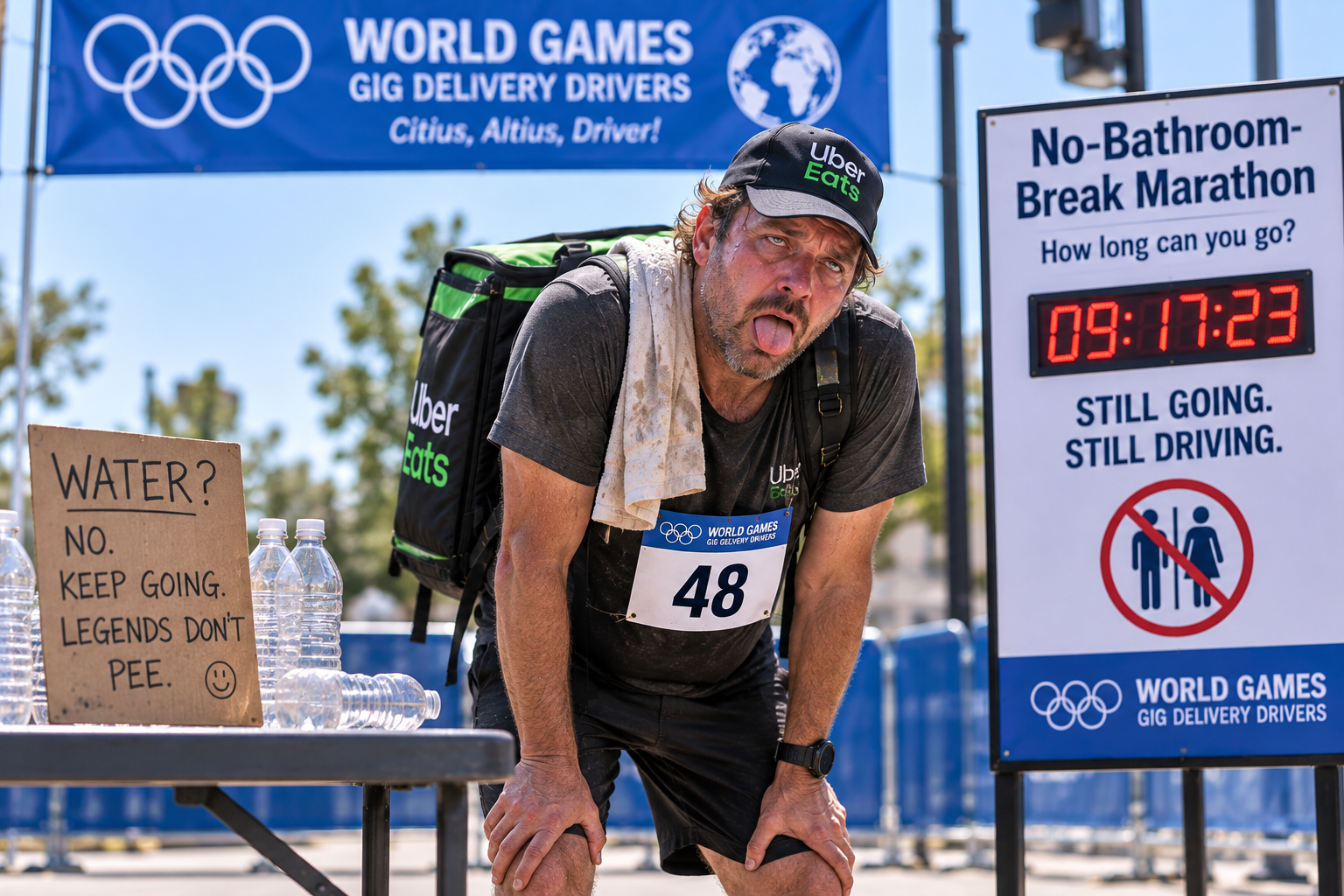
No-Bathroom-Break Marathon
Competitors attempted to complete the longest continuous delivery shift without finding an available public washroom. Canada swept the podium.
The gold medalist lasted nine hours, 17 minutes, visiting four locked gas-station bathrooms, two restaurants displaying “Employees Only” signs and one convenience store whose washroom had allegedly been “out of order since COVID.”
The medal ceremony was postponed for obvious reasons.
Longest Trip With No Tip
The emotional endurance event produced perhaps the Games’ most remarkable performance. South African driver Thabo Nkosi travelled 86 kilometres, climbed four flights of stairs, waited 19 minutes at the restaurant, located an unmarked rural driveway in darkness and delivered during a thunderstorm.
Tip: $0.00 The customer did, however, send a message saying: “Thanks bro.” Judges unanimously awarded gold.
Five-Star Customer-Service Diplomacy
Competitors were required to remain polite while responding to increasingly unreasonable customer messages. The final-round scenario began with: CUSTOMER: WHERE IS MY FOOD???
The driver had accepted the order 41 seconds earlier. Britain’s Sophie Clarke won gold after typing and deleting 17 responses before finally sending: “I’m on my way to the restaurant now. 😊”
Judges later examined the deleted drafts. Three officials required counselling.
Electric-Vehicle Charging Pit Stop
Drivers competed to locate an available charging station, recharge and return to deliveries.
The Netherlands entered as favourite. Unfortunately, all four chargers at the competition site were occupied. One was broken. One displayed an error message. One was being used by a vehicle that had finished charging 46 minutes earlier. The fourth was occupied by a gasoline-powered pickup truck. The event remains underway.
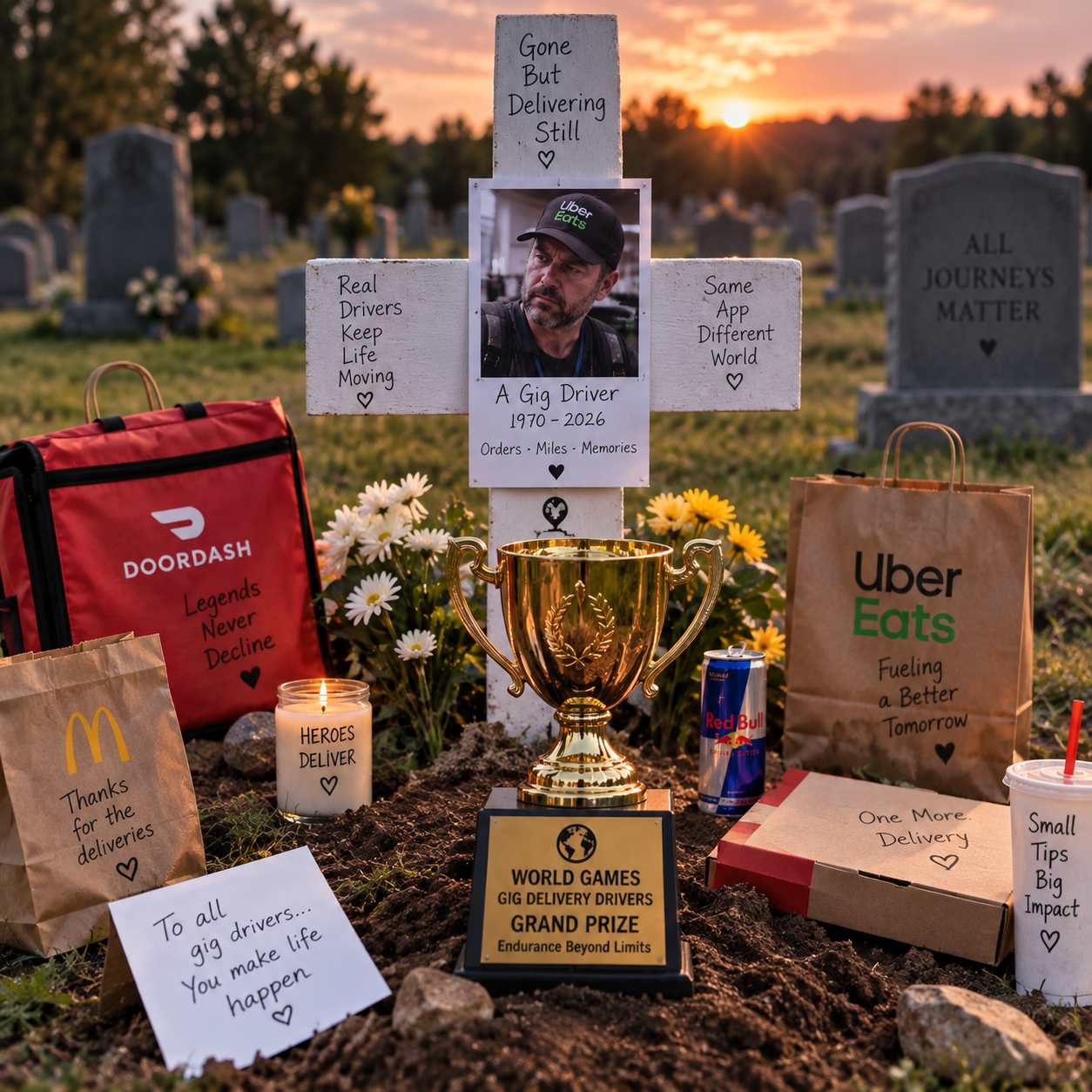
The Closing Ceremony
Athletes from 37 countries marched proudly into the stadium carrying insulated delivery bags representing their nations. The International Gig Delivery Federation declared the Games an overwhelming success and announced that preparations are already underway for next year’s competition.
The Olympic Committee has not commented on rumours that gig delivery could become an official sport. However, organizers believe the athletes are uniquely qualified.
They run. They lift weights. They navigate obstacle courses. They perform endurance events. They make split-second decisions under pressure. And unlike most Olympic athletes, they do all of it while trying to find Unit 4B in a building where none of the units have numbers.
The ceremony concluded with the traditional extinguishing of the Gig Games flame. Unfortunately, the driver assigned to extinguish it couldn’t find the entrance. The customer had forgotten to provide the gate code.