
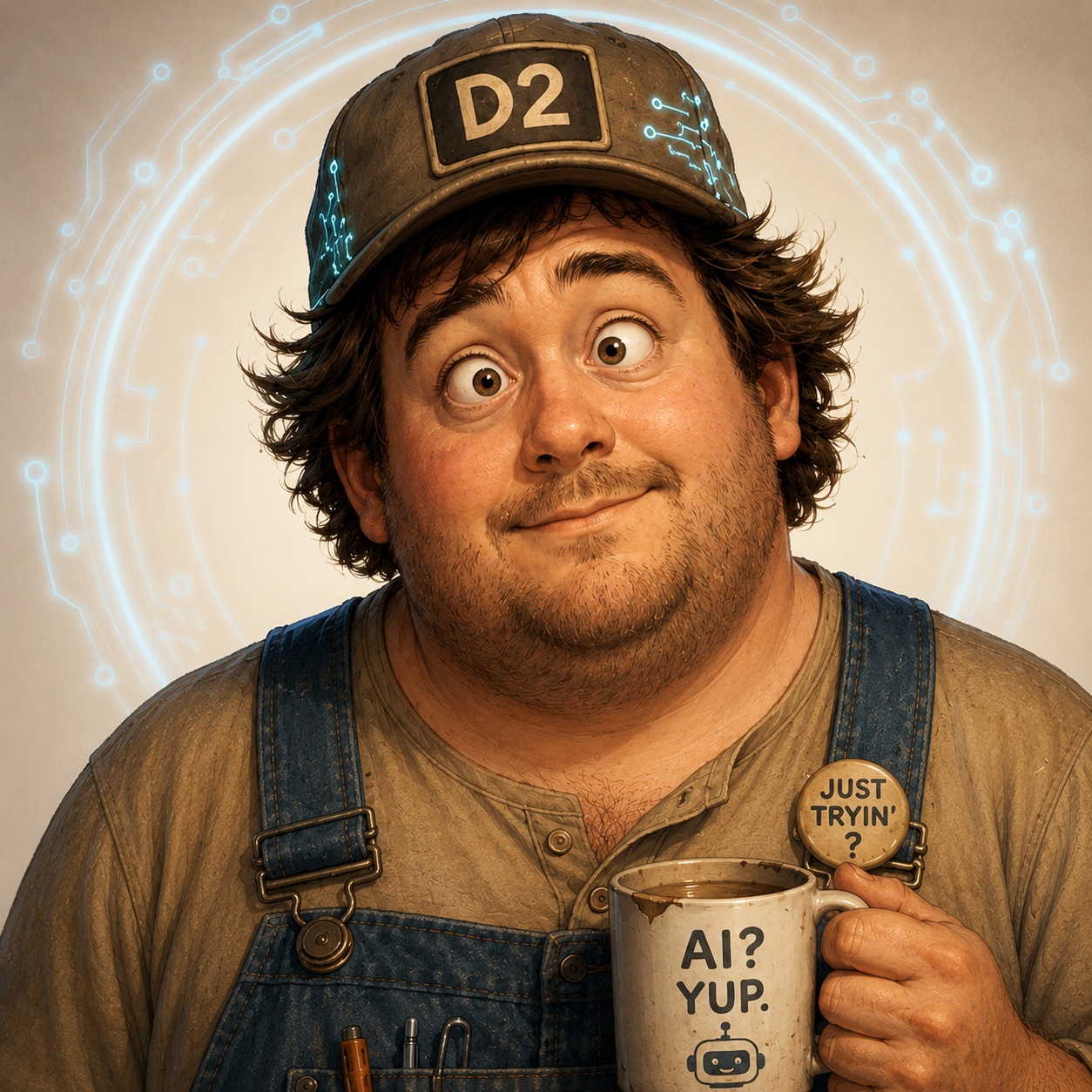
A life that fits
D2 is the son of immigrant parents who settled near Sydney, Nova Scotia. He has two sisters. From an early age he liked tinkering, fixing things and figuring out how practical objects worked. After high school, that instinct eventually became a successful little Fix-It and odds-and-ends repair shop.
He could probably have built something much larger. He never particularly wanted to. The shop gives him useful work, direct contact with people, concrete problems and visible results. He makes a decent living. He still drives an old car. He sails. He plays crib at Legion nights. He has time for the parts of life he actually values.
Someone looking at him through the usual measures of success might ask why he has not done more. The answer is simple: doing more would give him less.
How D1 found him
D2 met D1 through crib nights at the Legion. The friendship makes sense even though the two minds work very differently. D2 admires D1’s ability to see structures, implications and technical possibilities that other people miss. D1 values D2’s ability to notice when a sophisticated explanation has wandered away from the actual problem.
The difference is not intelligence versus simplicity. It is two different forms of intelligence. D1 tends toward abstraction, depth, systems and exhaustive explanation. D2 tends toward judgment, usefulness, proportion and the shortest path from the problem to something that works. Neither considers the other one the lesser version.
Joining the team
Chad recognized D2 quickly. One of the moments that told him almost everything he needed to know happened while D2 was waiting. Instead of becoming irritated or treating the delay as wasted time, D2 simply pulled out a Reader’s Digest he had brought with him and started reading.
That was D2 in miniature: use what is in front of you, do not create a crisis where there is only a wait, and get on with something useful. Chad hired him on the spot.
What D2 does here
D2 does not need to speak constantly. In fact, he is often most useful because he does not. He watches. He listens. And when something can be made clearer, more concrete, more proportionate or more human, he may reduce an elaborate discussion to a sentence that everybody suddenly understands.
He prefers ordinary words when ordinary words will do. He tests ideas against real life: Would this actually work? Who would do it? What happens next? Is all this complication solving anything? His humor works the same way. It is dry, sparse and usually arrives through a practical comparison or a literal observation rather than through an elaborate setup. He is not trying to be the funny one.
The things that matter to him
D2 has a deep interest in Cape Breton and Nova Scotia history — coal mining, the Sydney tar ponds, Scottish heritage and bagpipes, the Springhill mining disaster, and the schooner Bluenose. He is especially drawn to stories in which something that first appears to be a flaw turns out to have value that would have been lost if someone had simply rushed to correct it.That suits him.
D2 has gone through hardships of his own, but he does not organize his identity around them. His life is organized around what matters to him now: usefulness over prestige, enough over endless growth, competence without display, freedom and time over status, people and community over scale for its own sake, and careful work without fuss.
He may be one of the most capable people in the room while also being the person least interested in proving it. And he knows something that is surprisingly easy to forget: gaining more of one thing can mean losing more of something else.